
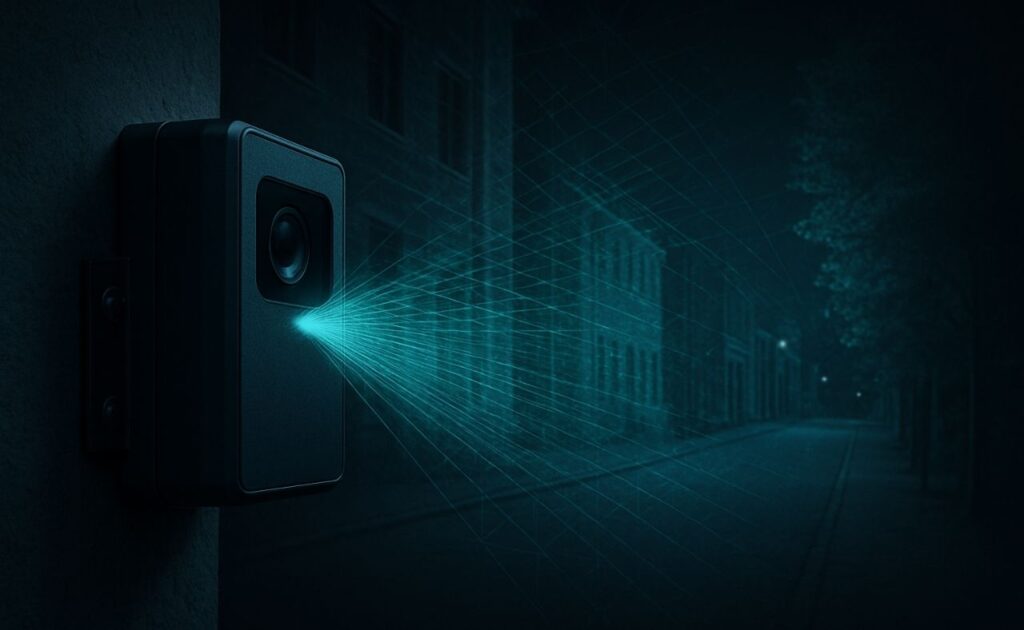
LiDAR–AI Integration as an Operational Response to Advanced Threats**
The main challenge in managing physical security systems today lies not only in detecting threats, but in filtering out noise and reducing false alarms. Perimeter defense systems—especially those covering large areas in factories, communities, or strategic facilities—chronically suffer from excessive false alerts.
This overload erodes operator alertness, wastes valuable response resources, and may ultimately lead to missing real incidents. The evolution of threats, ranging from sophisticated infiltrations to unmanned tools, demands a shift from a sensor-based approach to an integrated Sensor Fusion approach that delivers a reliable, operationally meaningful situational picture.
A new solution from Belltronics implements this concept in practice by combining two complementary technologies: LiDAR-based spatial detection and AI-based visual detection. At its core is the integration between the Israeli Opsys LiDAR sensor and the advanced TRUEN AI Edge PTZ camera series from Korea. The combination creates a multi-layered defense system that dramatically reduces false alarms and provides decision-makers with the high level of certainty required for force deployment and response.
Structural Reliability and 3D Spatial Detection
The foundation of the system is Opsys’s LiDAR sensor, designed for maximum durability and reliability. The technology is based on a Pure Solid-State architecture with no moving parts—a critical engineering advantage ensuring long lifespan and exceptional resistance to shocks and harsh environments for over a decade of operation.
For installers and security managers, this means drastically reduced maintenance requirements and long-term continuous operation.
The LiDAR scans its surroundings using advanced VCSEL and SPAD technologies. This combination enables real-time creation of a 3D point cloud, allowing for highly accurate detection and classification of objects, independent of lighting conditions. Additionally, the sensor delivers consistent performance in challenging environments such as direct sunlight, fog, or rain—conditions that significantly limit video-based systems.
Its built-in computing capabilities eliminate the need for an external processing device (Edge Device), reducing power consumption and system cost. These advantages allow simple, efficient integration with existing third-party systems such as VMS (Video Management Systems) and PSIM (Physical Security Information Management) platforms.
Key advantages of the Israeli OPSYS LiDAR:
- 3D scanning
- Works day and night without limitations
- Unaffected by direct sunlight
- No moving parts
- Long lifespan—up to 10 years
- POE, ONVIF compatible
- Fully standalone unit
- Built-in analytics
- No need for an external computer
TRUEN Cameras: Edge-AI Analytics for False Alarm Suppression
The second security layer relies on TRUEN’s TX camera series, equipped with advanced Ambarella AI processors, and in the latest generation, with groundbreaking HAILO AI chips from Israel—among the world’s leading AI processors.
This enables advanced Edge-AI analytics to run directly on the camera, without relying on external servers—resulting in high performance alongside cost and energy savings.
This reduces network and recording server loads and allows the system to operate in a more distributed and reliable manner. The AI algorithms classify objects with high accuracy, distinguishing between humans, vehicles, and animals—an essential capability for filtering out environmentally-induced false alarms.
The cameras also offer high-end specs suitable for professional security applications:
- Up to 8MP resolution
- Up to 40x optical zoom for long-range identification
- Excellent low-light performance with sensitive sensors and IR illumination
- Rugged durability standards: IP66/67, IK10
- Full ONVIF profile support
- H.265 compression for major bandwidth and storage savings
The cameras are NDAA compliant and contain no Chinese components, ensuring full compliance with strict international regulations. They also provide top-level cybersecurity using advanced protocols including TLS 1.2/1.3 and HTTPS over RTSP, ensuring maximum protection of transmitted data and preventing cyber risks in critical systems.
Integrated Edge Processing: The Operational Advantage of Sensor Fusion
The power of the solution lies in the integration between the two systems. In an operational scenario, the LiDAR serves as the primary detection sensor. It detects suspicious movement in a defined zone—even in poor visual conditions—and sends a precise alert with coordinates to the management system.
This alert automatically triggers the relevant PTZ camera (Slew-to-Cue), which focuses on the target. At this stage, the AI analytics activate:
they classify the object, confirm whether it is a real potential threat (e.g., a person rather than an animal), and begin continuous automatic tracking.
This automated process of detection, verification, and tracking provides the operator with a complete, clear, refined picture within seconds. The integration enables fast, informed decision-making, relying on the built-in capabilities of Opsys LiDAR working seamlessly with TRUEN PTZ cameras or with leading VMS platforms such as Genetec, Milestone, Hanwha, Network Optics, and others.
Conclusion
The integrated solution offers security managers and installers a perimeter defense system that delivers a significant leap in operational efficiency. It reduces reliance on human operators during initial detection, drastically decreases false alarms, and provides reliable data that shortens response time.
For organizations aiming to maximize their security capabilities, this is a strategic tool enabling a shift from reactive defense to proactive, data-driven protection.